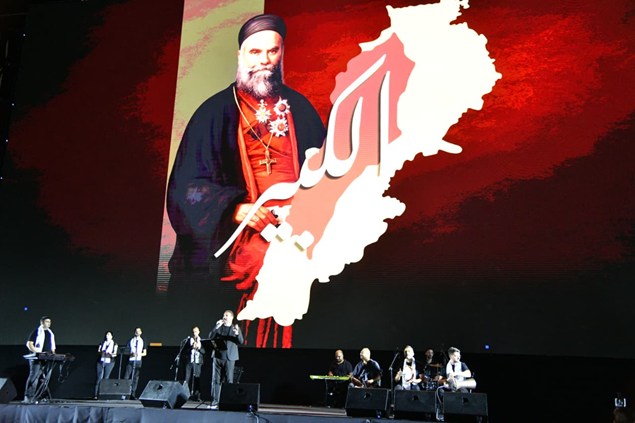
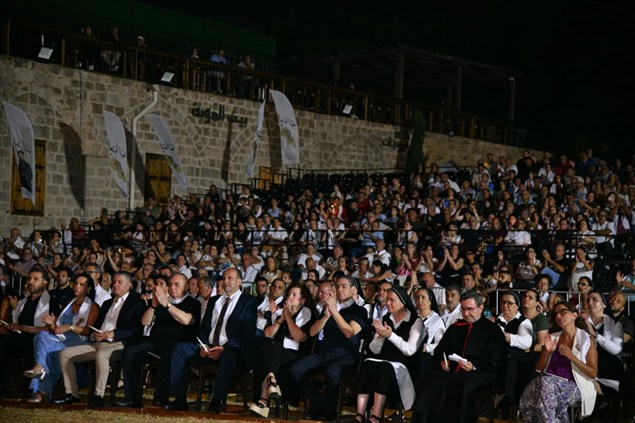
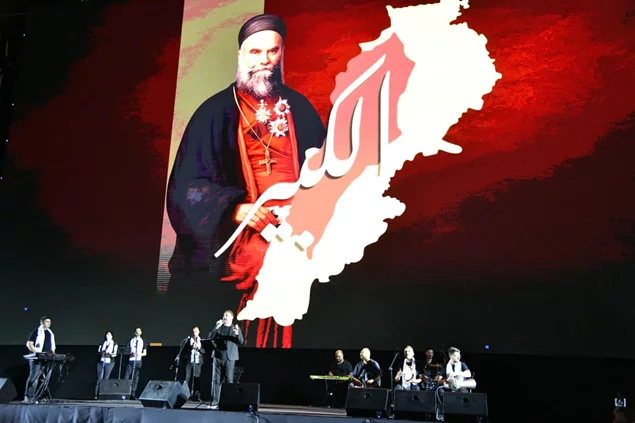
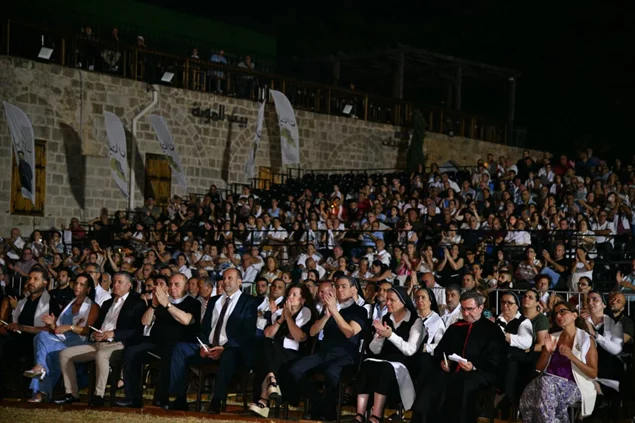
Batrouniyat organized an artistic and cultural celebration marking the beatification of Patriarch Elias Al-Hoayek under the title "The Great." The event conveyed national messages centered on reaffirming the vision of Greater Lebanon and the values it embodies: freedom, diversity, and openness.
In his keynote address, MP Gebran Bassil reaffirmed his commitment to the concept of Greater Lebanon in its full territory of 10,452 square kilometers, rejecting any attempt to diminish or partition it, and stressing the need to build a strong and modern state capable of preserving Lebanon's mission.
Bassil said:
"We gather today not to revisit a page from the past, but to reclaim the meaning that Lebanon's present and future require. The beatification of Patriarch Al-Hoayek is not merely a tribute to an individual or a religious community; it is a tribute to a national project embraced by an entire people and led by one man. The most beautiful aspect of this gathering is that it is taking place on the very land from which the Patriarch set out to embrace all of Lebanon."
Bassil noted that "this very land belongs to the Sisters of the Holy Family," adding:
"We have long known Al-Hoayek as the founder of Greater Lebanon, and that is true. Yet he did not merely draw geographical borders; he defined the boundaries of a national mission. He did not seek a state exclusively for Christians, but rather a state in which Christians would feel secure and whose stability would be safeguarded by genuine national partnership."
He continued:
"He could have chosen the easier course by demanding a smaller, more homogeneous and seemingly safer entity for Christians at that time. Instead, he chose the more difficult path. He chose a homeland built on partnership rather than isolation, on encounter rather than fear, and on mutual trust rather than domination. He chose Greater Lebanon not to expand territory, but to expand Lebanon's mission. He understood that diversity is not a weakness but a source of richness, and that differences do not prevent mutual recognition. A state succeeds not when one group prevails over another, but when all its citizens recognize themselves as equal partners. In this sense, Al-Hoayek was truly ahead of his time."
He added:
"Long before concepts such as pluralism, coexistence and consensual democracy became widely recognized around the world, Al-Hoayek had already translated these principles into a political vision for a successful state. He believed that the Lebanese could live together not because they were alike, but because they were different. This is precisely what made Al-Hoayek great. He never asked the Lebanese to abandon their identities; rather, he urged them not to allow those identities to become barriers separating them from one another or from their homeland. Greater Lebanon was therefore neither the triumph of one community over another nor a compromise imposed by circumstances. It was a civilizational choice founded on the conviction that freedom and partnership are the only path to building a unique and viable nation."
He continued:
"When the Vatican declares, on the centenary of the Constitution of Greater Lebanon, that Elias Al-Hoayek has been beatified, how can any of us abandon this great legacy? The Lebanese have every right to ask what remains of Al-Hoayek's vision. Our answer is that the homeland remains, as do the national formula and the National Pact. The state, however, is still waiting for those who will fulfill its promise. That responsibility belongs to all of us, not to Patriarch Al-Hoayek."
Bassil added:
"To those who ask about the role of Christians in this unstable homeland and this turbulent Middle East, our answer is clear: their role is to build, together with their partners, a strong state in a stable region. It is not enough to preserve Greater Lebanon; we must also build its strong state. Nor is it enough to call Lebanon 'The Land of the Message' while failing to make it a land of justice."
Bassil noted that Al-Hoayek and his generation answered one of the most decisive questions of their time: how Lebanon would come into being.
"It became the responsibility of those who followed him to answer another question: how to build the state that would protect Lebanon."
He continued:
"Lebanon has endured wars, crises and divisions, yet it has always risen again because the Lebanese remained committed to the idea of the nation-state. Today, however, the greatest danger is neither occupation, nor economic crises, nor even political division. The real danger is that the Lebanese may lose faith in living together within one state, and that each community may begin seeking guarantees outside the state. When confidence in the state is lost, everything else grows stronger at its expense, and external loyalties become more powerful than loyalty to the Republic."
He added:
"This is the difference between what Al-Hoayek envisioned and where we stand today. He wanted a partnership that would produce a state, yet the state has become hostage to disputes among its partners. He believed in the Lebanese choice, and in that sense we are his heirs. Many who came after him chose instead to place their hopes elsewhere some looked to the East, others to the West, and others relied on shifting regional and international balances of power. But political wagers do not build nations; choices do."
Bassil stressed:
"True fidelity to Al-Hoayek's vision lies in achieving the purpose for which he struggled. He emerged from the tragedy of famine, disease and mass emigration that claimed the lives of hundreds of thousands in Mount Lebanon. He witnessed suffering firsthand and understood that the value of a state is measured by its ability to safeguard the lives of its citizens, regardless of their sect, and by the justice it provides to all."
He continued:
"Lebanon lived in his conscience. He once said: 'I am the Maronite Patriarch, and Lebanon is my community.' In that sense, Patriarch Elias Al-Hoayek was as much the Patriarch of Muslims as Imam Musa Al-Sadr was the Imam of Christians. In that same spirit, he stands in continuity with Fakhr El-Din, Bechara El-Khoury and Riad El-Solh."
Bassil noted that, more than a century later, it is painful to see many of the challenges faced by Al-Hoayek's generation confronting Lebanon's youth once again.
"Greater Lebanon does not need a new identity, nor does it require dismantling its National Pact. What it needs is a stronger state. The Pact was never intended to produce paralysis, but partnership. Reforming Lebanon's political system does not mean abandoning partnership; it means freeing it from everything that has hindered it."
He stressed:
"Lebanon needs a strong state. A weak state can protect neither the country's existence nor the diversity upon which it was founded."
Bassil added:
"Lebanon also needs a productive economy, social justice, and a renewed respect for work, because the political freedom we advocate cannot survive on rent-seeking, patronage, or permanent dependence on foreign powers."
He continued:
"Today, we renew our commitment to the Lebanon envisioned by Al-Hoayek a Lebanon in which the state serves as a shared space for all its citizens. It is our responsibility to ensure that future generations believe in Greater Lebanon just as our fathers did. As Al-Hoayek himself said: 'Whoever does not love his homeland is an enemy of his ancestors.'"
Bassil concluded:
"The true measure of a state's success is its ability to restore trust, protect its people, safeguard their freedom and dignity, and open the doors of the future for them. This is how Greater Lebanon endures and renews itself, through the blessing of its founder, who walked the path of the saints."
He added:
"Here in the Batroun district, we established the Path of the Saints, linking Lebanon's saints Charbel, Rafqa, Hardini and Stephen. Tomorrow, Al-Hoayek will join them. The Municipality of Batroun has dedicated a street in his name, bordered by the school and university of the Sisters of the Holy Family, the congregation he founded."
Bassil further noted:
"Al-Hoayek's journey toward sainthood began in Halta, passed through Kfarhay, where the shrine of Saint John Maron is located, and concluded in Aabrine, where he was laid to rest at the Motherhouse of the Sisters of the Holy Family."
He concluded:
"We will continue to develop the Al-Hoayek Trail, which he walked time and again. We, the people of Batroun, walked that path with him, and we, the members of the Free Patriotic Movement, hope to follow in his footsteps along the path of Greater Lebanon's mission a Lebanon of 10,452 square kilometers. Lebanon will never disappear. We will never allow it to fall, vanish, or be fragmented. Greater Lebanon will endure."
The celebration featured a theatrical performance portraying Patriarch Al-Hoayek's life, his struggle, and his humanitarian mission, particularly during the First World War, with performances by actors Issam Ashkar and Youssef Haddad.
Poet Ibrahim Shahrour recited a poem inspired by the occasion, highlighting its national and spiritual significance. Director Charbel Khalil presented a video depicting an imagined dialogue between Patriarch Al-Hoayek and a group seeking to "shrink" Lebanon once again, in which the Patriarch reaffirmed his unwavering commitment to Greater Lebanon and its enduring significance in the face of attempts at annexation and partition.
The celebration also featured a song performed by Layal Nehme and Nader Al-Khoury, before concluding with a candlelit musical performance by a Maronite priest and his ensemble. The event was hosted by media personality Yazbek Wehbe.









.webp)



.png)
 EXCLUSIVE
 EXCLUSIVE
 EXCLUSIVE
 EXCLUSIVE
.jpeg)



.webp)