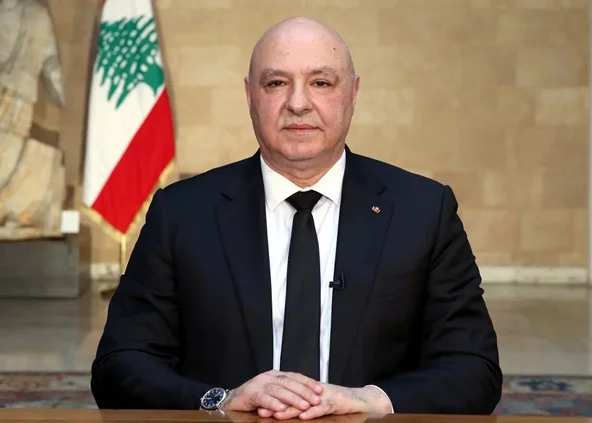
President of the Free Patriotic Movement (FPM), MP Gebran Bassil, said Lebanon must remain one unified country and state, and rejected the partition emerging in neighboring countries.
He was speaking at a gathering in the hall of Our Lady Mary Greek Catholic Church, Qabb Elias, Zahle. The meeting was attended by Mayor Salah Taleb and the leader of the Popular Bloc, Myriam Skaff.
Bassil said Lebanon is rich in its diversity, stressing the importance of balance between Lebanese residents and expatriates. He hoped the Bekaa “will get its rights,” calling for an agricultural policy that protects farmers.
“Agriculture is not just a profession. It is a livelihood,” he said, noting that Lebanon is small and is often described as non-industrial. “Is it only a service country?” he questioned, rejecting that idea and arguing that this mindset weakened the country.
Bassil believed this mindset turned Lebanon into a consumer economy and encouraged dependence on a banking system built on interest instead of production. He said the banking and financial model was designed so that interest returns outperformed “any other work.”
As a result, he argued, people were pushed toward “laziness,” believing their money was better off in banks.
“That’s how they took our money,” he said.
Bassil also said people were told their deposits were safe and that the dollar peg was secure, warning that the same approach could be repeated today “under different titles,” which he said had been used to mislead the public.
Turning to former central bank governor Riad Salameh, Bassil cited that Salameh paid for the awards he had claimed, and when Salameh could no longer sustain that, the truth was revealed.
Bassil said the FPM was among the few to speak out against him because, he claimed, they refused to be bribed. He added that others stayed silent because they were bribed, arguing that he is facing accusations now because European courts cannot be bribed. Bassil said the FPM was in the government, and they warned about the looming crisis.
He pointed to a 2019 press conference by former Minister of Economy Mansour Bteich, saying it exposed the country’s financial reality. Bassil said they then pursued an economic approach and tried to pass budgets with “real reform,” arguing Lebanon cannot recover without clear policies.
He said the Lebanese diaspora was successful, while the state had failed, stressing that if the people were incapable, they would not have endured nor shown the ability to survive despite a so-called completely absent state.
Bassil also highlighted efforts to secure citizenship rights for expatriates and descendants of emigrants.
He explained that a law was passed to allow those who left 150 years ago to restore their nationality, but the required decrees have still not been signed.
Bassil then stressed the role of Lebanese families, saying that the FPM preserves the presence of families and rejects what he called a “policy of elimination.”
Opening of the Electoral Machine Office
Bassil’s visit to Qabb Elias was part of a broader tour in Zahle.
He was accompanied by his Vice Presidents for administrative and political affairs, Ghassan Khoury and Martine Najm Kteily; MP Salim Aoun; former minister Gaby Layoun; Head of the Administrative Reviews Committee Ibrahim Al-Rami; Head of the Public Relations Committee Joumana Sleilati; and Head of the Media Committee Michel Abou Najm.
His tour began in Ksara, where he opened the FPM’s electoral machine office.
“My visit to Zahle is a message of support for the work you are doing here,” Bassil said, congratulating the district committee. “Zahle matters to Lebanon and to the FPM, and we must treat that importance with a real sense of responsibility.”
Bassil said the party must do more in Zahle and praised the district committee’s work, urging it to keep going.
He said the FPM remains committed to its principles.
He also called for stronger outreach to residents to reinforce the party’s presence and address the concerns of Zahle and the wider district.
Meeting with Professional Sectors
Bassil then met with self-employed professionals and representatives of other sectors at the Kadri Hotel, in a discussion moderated by journalist Natalie Issa. “I’m happy to be in Zahle,” he said.
“There is no need to explain why Zahle matters, given its location, size, and capabilities. It is Lebanon’s breadbasket. It has agriculture and industry. It is a city of production, with a measure of self-sufficiency.”
Bassil said the issue lies in what more can be done in Zahle, even as its agriculture and industry remain active.
He pointed to administrative decentralization, saying it would give Zahle greater powers. He also highlighted the trust fund, arguing it could finance major projects for the area, including land and sea transport.
He said the political class keeps circulating the same ideas “out of laziness,” adding that Zahle still has untapped potential, especially in tourism and broader development.
On the economy, Bassil said the current government has not put forward any economic plan or even a clear idea.
He said it keeps tying economic decisions to other files, arguing that there is still liquidity in Lebanon, citing imports of about $20 billion in 2019.
He added that $7 billion could reach the country through the diaspora. “That means around $12 million is in Lebanese hands,” he said, yet Lebanon still lacks an economic policy.
He said he paid a political and popular price for opposing the salary scale in 2017, arguing that “you cannot govern through populism.” He added that, in Lebanon’s history, it is unprecedented for someone to back a decision in cabinet and then vote against it in Parliament.
Bassil also claimed the Minister of Energy, Joseph Al-Saddi, did not merely approve the decision, but helped shape it and reached an agreement with fuel station owners on the increase.
“I have evidence,” he said.
He described the current administration as a “government of failure,” arguing it passes laws while knowing they will not be implemented. He said the bottom line was a 25% increase, despite what he described as earlier efforts, when he was at the Ministry of Energy, to reduce energy costs.
Bassil spoke about a project to upgrade the road linking Zahle to Metn via Bchlama, estimated at $27 million, saying work on it has stopped. He stressed that his party would push to complete the project.
He added that the FPM’s economic plan includes proposals for the airports of Rayak, Akkar, and Hamat, and said the proposal was submitted in writing. He argued that just as Akkar MPs lobby and apply pressure for the Akkar airport, Zahle MPs should do the same to move forward with the Rayak airport project.
He said they would commit to that in the next Parliament.
According to Bassil, Zahle has strong economic potential and should pursue clear tourism, development, agricultural, and industrial strategies.
He reiterated that the FPM believes in one, undivided Lebanon, calling that the country’s strength and advantage.
He said Lebanese must be “pioneers.”
He added that, despite limited resources, the party has worked in more than one region, and said he hopes it will be allowed to carry out a development project in Zahle, as it did in Tripoli.
Visit to the Home of Blessed Father Bechara Abou Mourad and Meeting in Qaa Al-Rim
Bassil later visited the home of Blessed Father Beshara Abou Mourad in Zahle. He then went to the hall of St. Charbel Church in Qaa Al-Rim, where he held a meeting attended by Mayor Ghassan Sleiba and mukhtars.
He again highlighted the Bchlama–Baabdat project, which would link Zahle to Metn and is estimated at $27 million.
Bassil was pleased to hear about a separate project to connect Qaa Al-Rim to Baskinta, but said it does not replace the larger plan to link Zahle to Metn.
Bassil said residents have no choice but to live in peace with one another and with their surroundings, stressing that political and ideological disputes are normal, “but we must live together.”
He stressed that Hazerta is not cut off from them. He said their relationship is built on long-standing ties and open hearts, and urged the same spirit in relations with the wider area.
He said the least the FPM can do is act as a bridge between everyone. He stressed that people must live together in peace in a region shaken on all sides.
According to Bassil, some people are stirring up tensions in Lebanon, and he warned that Lebanese cannot live on hatred because it would eat them up.
“We are trying to uphold our national ethics to protect you,” he said.
“It is our duty to speak up when others lie to you, but to clarify the facts, not to sow poison among us.” He added that political competition is legitimate, as is engaging directly with people “to guide them to the right path.”
He said that even outside government, the FPM remains bound by national responsibility.
He stressed the need for economic policies, adding that “it makes no sense to collect money through taxes when we know funds have been smuggled abroad.”
He said Lebanon should export Lebanese products and ideas, “not only young people and brains.”
He added that when the FPM speaks about protecting the diaspora, it often ends up speaking alone, even though it serves Lebanon’s interests. He noted that most diaspora voters do not support the FPM, yet the party still pushes for their rights “because our approach is not one of exclusion.”
Bassil said it is good to be outside government, but that it does not absolve them of national responsibility, stressing that changing the electoral law shortly beforehand was a constitutional violation.
Bassil spoke about what he called a “memorandum to join issue” against the Ministry of Foreign Affairs.
He said the candidacies that were submitted confirm that the diaspora has the right to run for office.
He stressed that Lebanon is revitalized by expatriates and their successes, adding that his party is not fighting this battle for electoral gain but “for Lebanon’s existence.”
He added that Lebanon cannot live without the diaspora and that this must be translated into action, not just words.
“Are we meant to carry the cross of defending diaspora rights alone, while others write poetry about them?” he asked.
Bassil said elections are an opportunity to engage with people, hoping there would be no disruption.
“No one changes the electoral law in an election year,” he concluded.
A commemorative gift was presented to Bassil, depicting Saint Charbel.
Opening of the Jdita Office
Bassil also opened an FPM office in the town of Jdita, amid a large crowd of supporters.









.webp)



.png)



 EXCLUSIVE

.png)

.webp)