 <
<
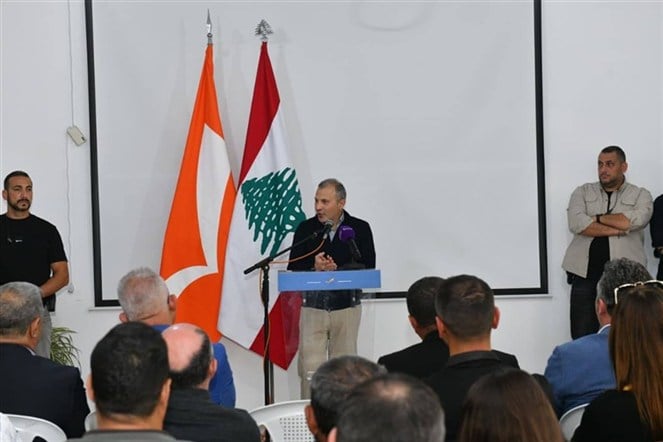
The head of the Free Patriotic Movement (FPM), MP Gebran Bassil, began his tour in Akkar with a meeting at the Safinet al-Draib Municipality. The meeting was attended by MPs Jimmy Jabbour and Asaad Dergham, FPM Vice President for Political Affairs Martine Najm Kteily, Vice President for Administrative Affairs Ghassan Khoury, Political Council members Walid al-Achkar and Haidar Issa, potential candidate Fadi Barbar, several mayors, and town residents.
Meeting in Safinet al-Draib
Bassil expressed his pleasure at visiting the town for the first time, noting that Municipal President Joseph Abdallah, known for his integrity and generosity, had extended an invitation that he was honoring that day. He said there was also a prior commitment to visit Menjez, which he was fulfilling during this tour.
He explained that whenever he visits a new town on Lebanon’s peripheries, he remembers his travels as Minister of Foreign Affairs, explaining that these visits aim to encourage residents to remain in their villages, particularly in towns that have long felt forgotten.
Bassil stressed that administrative decentralization is what can truly secure people’s rights by turning towns and municipalities into active, elected authorities with the financial means to operate. He highlighted that major towns often receive the largest share of state resources, while decentralization would ensure that even remote areas automatically get their fair share. For example, he cited mobile phone revenues, recalling that the FPM had fought for municipalities to receive 10% of telecom bill revenue. He explained that, under the current system, the transfer of these funds depends on the Minister of Finance, whereas under decentralization, the transfers would occur automatically.
He emphasized that what matters most for Akkar is that its people remain in their region and that its towns do not become depopulated. He also said that political obstruction had prevented the completion of several projects, depriving Akkar of 200 megawatts of electricity that were supposed to be supplied through ongoing works.
For his part, the President of Safinet al-Draib Municipality, Joseph Abdallah, welcomed Bassil and said the meeting provided an important opportunity for communication and engagement among residents. He highlighted that the town is rich in its people, especially its youth, many of whom serve the state through their role in the Lebanese Army.
Addressing Bassil, he expressed the town's appreciation for his efforts in defending the rights of Lebanese citizens and sees in his positions a clear direction toward state-building. He reaffirmed their loyalty to the political approach established by President Michel Aoun and added that the town’s strength is reinforced through cooperation with neighboring villages.
Abdallah also stressed that residents’ decision to remain in their villages is itself a contribution to supporting the local economy.
Visit to the Town of Menjez
Bassil then visited the town of Menjez, the second stop in his Akkar tour. He visited the Beit Jaalouk shrine and the Heritage House, where he listened to a brief presentation on the village’s history. He then took a field tour of an archaeological site featuring one of the megalithic tombs, followed by a visit to Our Lady of the Border Fortress. His visit concluded with a meeting with residents in the hall of Mar Daniel Church.
In his remarks, Bassil said they had long awaited this visit, noting that the first person to request it had been the former municipal president. He told residents that they inherited a rich historical legacy they are responsible for preserving, adding that the Maronite Church has remained steadfast despite all the events it has endured.
Bassil said that Menjez is not only a border town but also a heritage town, and that preserving such a place is not easy. He observed that the town had lost many martyrs who sacrificed themselves because they resisted, stressing that nothing is more valuable than human life; they give their lives while others continue the fight despite difficult circumstances and the absence of the state.
Bassil also added that their message in this land is one of faith and steadfastness, especially at a time when Pope Leo XIV is visiting Lebanon. He concluded by stating that the true challenge lies in practicing faith and resilience while living joyfully with others and aspiring for a peace that is not built on surrender.
For his part, the parish priest, Father Mario Demian, said that on behalf of Bishop Youssef Soueif, he welcomed Bassil to the Menjez parish.
He observed that Bassil’s presence wields influence, especially in a region with many needs, including Akkar, which has long been underserved. He added that Christians do not give up, and Maronite parishioners remain resilient, having sacrificed martyrs on the altar of the nation. They are determined to stay on their land, which holds historical significance, its heritage, landmarks, and a people deeply connected to it.
Remarks were also delivered by the FPM Menjez coordinator, Michel Isaac, and the Municipality's President, Tony Antonios.
Syndicates Lunch in Qubayyat
Bassil also attended a lunch organized by the syndicates in Qubayyat.
In his remarks, he said that the FPM had sent a memorandum to His Holiness Pope Leo XIV expressing the movement’s vision, noting that the Pope’s visit reaffirms that Lebanon is a message that must be preserved, especially as it faces multiple threats.
Bassil explained that the first danger comes from Israel and the second from Syria. He said it is impossible not to worry about what is happening in Syria, adding that the Syrian president is now expected to fight terrorism, “the same terrorism that brought him to power,” and that the fear lies in the possibility that this fight could spill over into Lebanon.
He emphasized that Lebanese and Syrians depend on each other, and the only goal is a stable relationship between the two groups. He also pointed out that the daily threats of war in Lebanon cast doubt on whether elections will happen at all.
This situation requires them to approach the elections as if they are happening tomorrow, highlighting the importance of unity and solidarity to confront this national challenge.
For his part, MP Jimmy Jabbour stated that they are dedicated to addressing the concerns of this social and professional class, including teachers’ salaries, employers’ ability to adapt, and the challenges faced by various sectors in these circumstances.
He mentioned that they started with a meeting with army retirees and are expanding their outreach to various groups to reaffirm that Akkar is both an army and an educational community.
Jabbour emphasized the importance of collective effort to rebuild society, noting that Lebanon can only thrive with a strong middle class.